

 8613480627251
Aviation forgings prefer materials with high specific strength and high specific stiffness. The materials used for large aviation forgings mainly fall into three categories: titanium alloys, ultra-high strength steels, and aluminum alloys.
I. Titanium alloys for large aviation forgings
Titanium alloys, with their advantages such as high specific strength, high specific stiffness, and good corrosion resistance, are widely used in the aviation industry, effectively reducing the weight of aircraft structures and extending the service life of components. Military aircraft extensively utilize titanium alloy forgings for key load-bearing components such as wing spars, bulkheads, and landing gears. These forgings are characterized by their large single piece weight, as well as their large overall dimensions and cross-sectional area.
Typical application case: The main landing gear bracket beam of the Boeing B747 features eight part numbers utilizing Ti‑6Al‑4V titanium alloy forgings. Each individual piece weighs 1724 kg, measures 6.2 m in length, and has a projected area of 4.1 m². The main landing gear load-bearing beam of the Airbus A380, featuring a six-wheel, three-axis trolley design, opts for Ti‑1023 titanium alloy forgings, with a length of 4.255 m and a weight of 3210 kg. The bulkhead of the US military F‑22 fighter jet utilizes Ti‑6Al‑4V ELI forgings, with each piece weighing over 771 kg and having a projected area of 4.06 m².
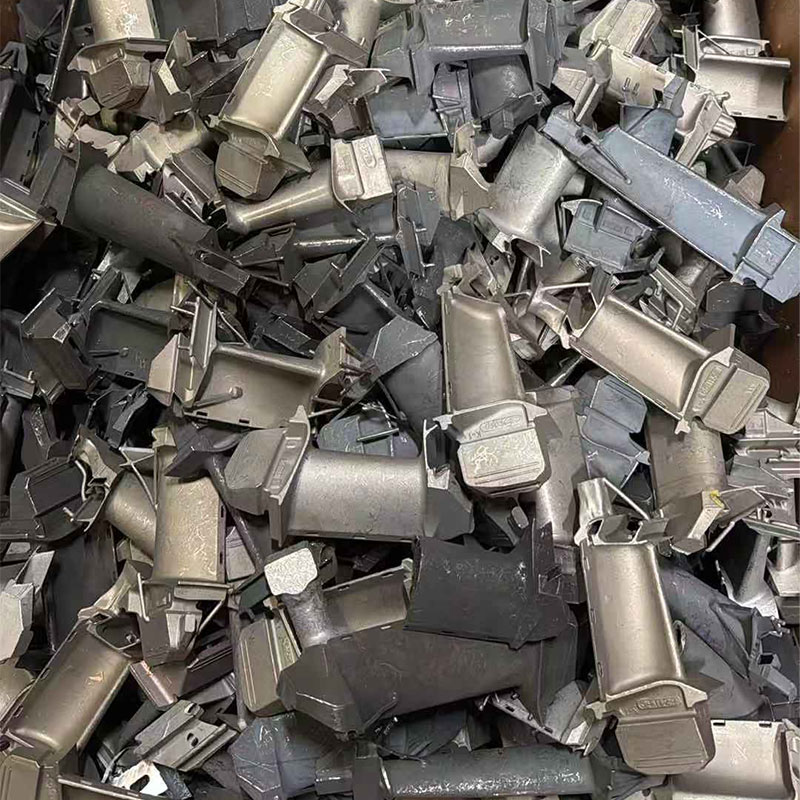
Commonly used titanium alloy grades in aviation include TC4, TC18, TC21, TA15, TB6 (corresponding to American standard Ti-1023), etc. Among them, TC18 has excellent hardenability and is suitable for the manufacture of large forgings, making it the most widely used grade in China at the current stage. In response to the demand for civil aircraft, Russia has developed Ti-55531 titanium alloy based on TC18 by reducing the content of the easily segregating element iron. This alloy has high strength, good hardenability, and a wider hot working window, and has been applied to components such as A380 suspension joints and landing gear struts. Domestic research and development of this material for localization have been carried out for the C919, and heavy-duty helicopters also use Ti-55531 to develop hub central components. Compared to TC18 and TC21, Ti-55531 has higher tensile strength, but lower plasticity and fracture toughness; however, it exhibits superior crack propagation resistance under the condition of Δk=11 MPa·m¹ᐟ², with longer crack initiation life and higher fatigue limit, making it suitable for long-life structural design.
II. Ultra-high Strength Steel for Large Aerospace Forgings
Ultra-high strength steel generally refers to steel with a tensile strength greater than 1400 MPa and a yield strength greater than 1200 MPa at room temperature. It is required to possess good ductility, fatigue resistance, fracture toughness, and stress corrosion resistance, and is commonly used in key aviation components such as landing gear, transmission gears, main bearings, and connecting bolts.
In the early 1950s, China developed 30CrMnSiNi2A ultra-high strength steel, with a tensile strength of up to 1700 MPa. In the 1970s, leveraging domestic resources, China further developed 32Si2Mn2MoVA and 40CrMnSiMoVA steels. Starting from the 1980s, relying on foreign technology and new vacuum smelting processes, China successively researched and developed grades such as 406A, 35CrNi4MoA, 300M, and 18Ni martensitic aging steel, laying a material foundation for the development of China's aviation industry.
Currently, there are three major development directions for ultra-high strength steel in large aviation forgings: first, ultra-high strength steel with a strength level of 2200 MPa or higher, which, while ensuring high strength, exhibits superior comprehensive performance in terms of ductility, fatigue resistance, crack propagation rate, and stress corrosion resistance compared to mature 300M steel; second, ultra-high strength stainless steel, which serves as an alternative material for the landing gear of next-generation carrier-based aircraft; and third, low-cost ultra-high strength steel, which is targeted at scenarios with moderate performance requirements such as civil aircraft and large unmanned aerial vehicles.
III. Aluminum Alloys for Large Aircraft Forgings
Aluminum alloy, with its low density and high specific strength, possesses corrosion resistance, excellent plasticity, and processability, and its cost is controllable. It has long been used as the core material for aircraft airframe structures. The main types of aviation forging aluminum alloys are the 2XXX series (2024, 2224, 2324, 2424, 2524, etc.) and the 7XXX series of ultra-high strength aluminum alloys (7075, 7475, 7050, 7150, 7055, 7085, etc.).
The 2XXX series belongs to the aluminum-copper-magnesium alloy category, also known as high-strength hard aluminum, with a wide range of applications. Its tensile strength ranges from 400 to 500 MPa, and its room temperature strength is lower than that of the 7XXX series. However, it excels in heat resistance and resistance to fatigue crack propagation. The representative grade, 2124, is used in the main structure of the F-22 and F-35. The 7XXX series is an aluminum-zinc-magnesium-copper alloy, characterized by high specific strength and hardness, as well as good toughness and processing performance. The typical grade, 7050, is predominantly used for main load-bearing forgings such as reinforcement frames, load-bearing beams, and joints.
Through microalloying optimization and heat treatment process regulation, China has developed the 7A85 aluminum alloy, which has comparable performance to the foreign 7085 alloy. This alloy increases zinc content, reduces magnesium content, and strictly controls iron and silicon impurities. While maintaining high strength, it exhibits outstanding toughness, fatigue strength, and stress corrosion resistance; its hardenability is significantly better than that of 7050-T7452, with a hardened layer depth of up to 305 mm (compared to 203 mm for 7050), making it more suitable for thick and large-section aviation forgings. The foreign 7085 alloy has been successfully used in components such as the main beam and rib plates of the A380 wing, with the main beam being 6.4 meters long, 1.9 meters wide, and weighing 3.9 tons, making it one of the largest aluminum alloy forgings in the world.